In early 2021, shortly after joining an ad agency full-time, I inherited an idea and some funding to create a consumer insights community. The idea was to carry out qualitative research on a long-term basis and to build a resource and capability in support of the agency’s thought leadership platforms. Or perhaps the idea was far less developed than that when it was handed to me (🤔), but what I can say for sure is that I had some money, I had the freedom to build and explore, and I had some guardrails to help guide me in my ideation. Dream.
It was, and continues to be, my favorite part of the work I do. Essentially, it turned out to be an ongoing ethnography, spanning more than 5 years and contributing to countless studies for clients, several new business wins across the agency network, many research insight reports, and thousands of kilometers traveled to present learnings to executives across the US and Europe. Ethnography is the bread and butter of anthropologists; our discipline developed the methodology, after all! Long-term research is a concrete way that I have seen academic rigor produce business results, and in this article I will explain the business impact it has had.
One note: I’ve seen this kind of tool/capability called several different names [consumer insights community, qualitative research panel, consumer panel, online research community, MROC, customer advisory board], and I will use some of them interchangeably in this article. Below, I outline how to deploy a consumer insights community using examples from my own work over the years.
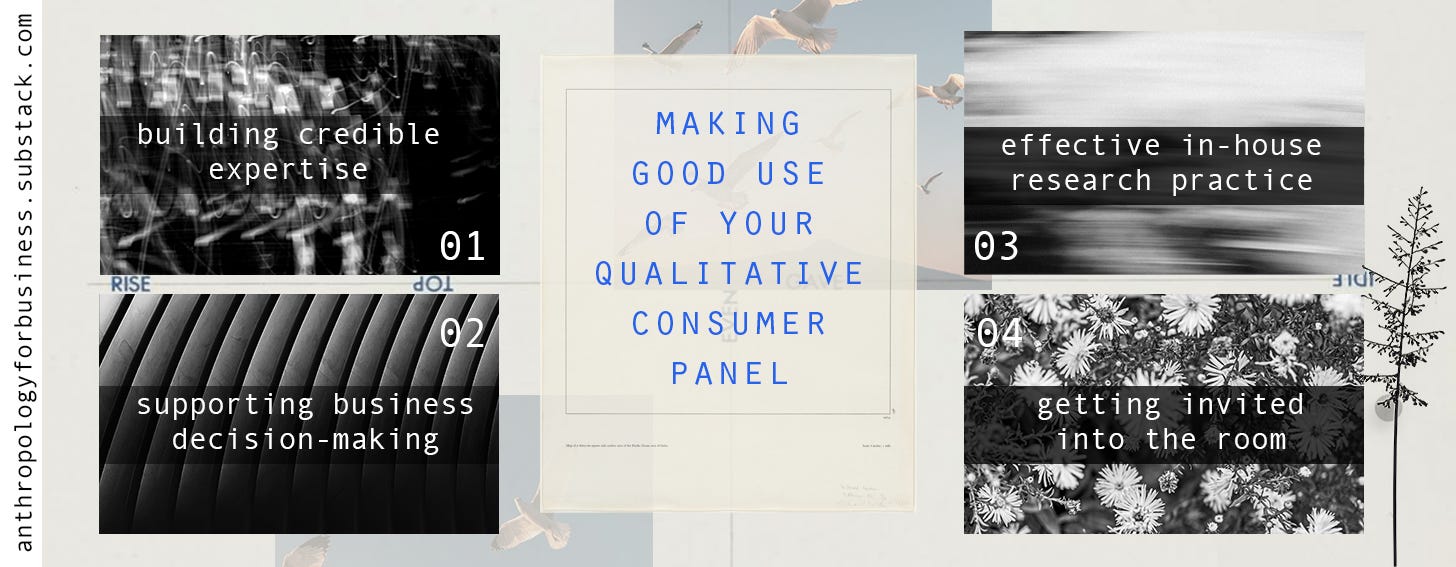
Alright! Let’s get into it. In my experience, the various types of business impact tend to cluster around four main themes. And not all four are applicable to every organizational structure, but they are as follows
- Builds credible expertise
- Supports business decision-making of consequence
- Serves as the foundation of an effective research practice
- Gets your company in the room
Within each of these four clusters, there are several ways to use your consumer panel that ultimately drive that business impact.
BUILDING CREDIBLE EXPERTISE
Without getting into the how of running a consumer panel, the mechanics of engaging with a group of people over time on a variety of subjects means that, almost by default, you can build real knowledge and expertise. If you are as pointed as I was in handpicking the right people for my panel (meeting a certain level of affluence, regular international travelers, adhering to a particular mindset as determined by a set of 13 questions) then you will almost certainly become an authority in specific arenas that are of import to your company or agency. For me, that meant having an earned expertise in a subset of global affluent travelers and luxury consumers. With thought leadership being an important way of participating in global business culture today, an insights community primes an organization to be able to do just that.
When you have a real expertise, you are able to accomplish the following:
- You have a POV. In this day and age, we have all witnessed that brands and companies are expected to have a POV. It’s the case on many politicized issues, but it’s also the case in PR. At the agency I was working for, the PR team often came to me with something like, “I’ve seen press conversation around affluent parents refusing to buy their teens smartphones. What can we contribute to this conversation?” From there, I am either able to answer immediately based on past discussions, research, and data, or I am able to quickly discuss with panelists so that we can pitch or respond with our POV. I already have the built-in context of knowing my panelists and their lives, so the POV is far richer than it would be in survey results or in a one-off qualitative study.
- Leadership is better prepared for conversations. In my case, our C-suite executives were often doing interviews, appearing as guest speakers on a podcast, presenting at industry conferences, or attending various leadership councils. Prior to these engagements, I was often asked for a few insights they could share in the conversations they were entering. Furthermore, by virtue of being an agency constantly engaging in new business pitches, the expertise I had built for our agency through the panel often aided leadership in being prepared for conversations with brands that were curious about growing their affluent consumer base.
- It provides the forum for spotting societal shifts. Thankfully, the panel gave me the time and the space to follow my curiosity and investigate shifts that I sensed were coming. As an anthropologist, this brought me intellectual fulfillment. As a business-minded woman, this helped our agency be ahead of the shifts. I’ll give you a concrete example. Back in 2021 and 2022, the conversations I was having during some “catch-up IDIs” with members of my insights community produced some early signals to me that how they think about and inhabit belonging might be shifting. At the time, it wasn’t enough to build a report around, but it stuck with me nevertheless. In 2025, after a conversation I had with a respected colleague on why status matters in social settings, I decided to study how belonging was concretely shifting, starting with the hypotheses I had been developing over the years. After nearly a full year of exploring the subject, I was able to produce a report at the beginning of the year on how belonging is shifting amongst the affluent. Interestingly, I saw McKinsey just put out a similar report. 😏 This is not the only example I have. There are many shifts, big and small, that we’ve been able to spot before the wider public was aware, precisely as a result of this ongoing qualitative insights community.
SUPPORTING BUSINESS DECISION-MAKING
The role that an insights community plays in business decision-making depends on the type of organization you are, but I firmly believe that whether the panel is run by an agency, a brand, an enterprise, or even a small business — its most useful role can be informing teams and leaders so that they feel confident about the decisions being made.
These are the consumer panel use cases that I have seen guide client decisions:
- Keeping abreast of cultural shifts. One of the agency’s core clients was Lexus, and as their agency-of-record, we were always seeking ways to add value and use our proprietary knowledge to support their internal initiatives, particularly when it overlapped with the strategy and creative we produced for them. As the world continues to change, especially with regard to electric vehicles and the massive shifts in the luxury market, we felt it could be useful for several of their teams to put together a research-backed POV on the future of luxury. Selecting the participants from the panel who fit within Lexus’s target customer profile, I ran a study to get a sense of where luxury is heading, how it will fit into their lives moving forward, and how they see Lexus within some of those ideas and concepts. We then presented and discussed our learnings in a workshop with a group of Lexus clients.
- Topical knowledge relevant to the industry. Similarly, one of our luxury hospitality clients was in need of some ongoing insight and inspiration over the period of a year after having a change in leadership and restructuring of their luxury business. Together we decided that a useful value-add would be to bring one topic to the affluent consumer panel per month, followed by the preparation of a mini-report to share out in a casual meeting at the end of each month. Each month I agreed with clients on a topic (e.g., food and bev while traveling, wellness practices, etc) and then proceeded to do 1-2 short digital activities with members of the panel on the subject, analyzed the learnings, and made a mini-zine to walk the clients through. The mini-zines also served as take-home materials that the organization could include in their repository of research/consumer insights. Having those reports, and that ability to have a consumer voice on some of the subjects that were top-of-mind as they worked through service offering improvements, helped to guide some of their internal discussions.
- Concept testing for communications and services. While the previous two examples were about general insight or knowledge, there were also many cases in which the panel helped clients make very specific decisions. After the majority of our clients became aware of the panel and various use cases they might have for it, a recurring favorite ask for them was to get feedback on concepts for ads, or copy, or service programs they were designing. Through concept testing, clients were reassured about launching things into the world because feedback either confirmed that the plans or direction would work well, OR the feedback helped us make changes that would improve the work. One of my favorite examples is from the Ritz-Carlton Kapalua campaign “Restore Yourself to the Wild.” During the creation phase, before launching the campaign, we used the consumer insights community to decide on the final direction for the creative. Here is one example of the output:
- High-stakes decisions. Finally, the panel has also been instrumental in helping organizations during the process in which they are making high-stakes decisions. Obviously, there are many inputs when it comes to decisions of high consequence, but the perspective of the consumer is an important one. Over the lifecycle of the customer insights panel, I was asked to develop and execute numerous studies whose insights would be used in executive meetings or summits while making weighty decisions about the business. This was most common in hospitality, but also occurred in financial services. Without going into too much detail to protect the proprietary nature of such decisions, I will say that I designed studies to understand the consumer experiences, values, and perspectives for the following: a hotel group’s purchase of a wellness brand, a wealth management company’s service design, an exclusive loyalty program design in luxury hospitality, and a bank’s rewards card system.
HAVING AN EFFECTIVE RESEARCH PRACTICE IN-HOUSE
I know that not every organization aspires to having a full-time research capability in-house. But for those that already have or want to have a qualitative research capability, an ongoing qualitative research panel can be instrumental in ensuring the efficacy of your research practice. There are several ways that my insights community fed the qualitative research practice that I led at the agency:
- Quick turnaround research. As many of you know, agency life is fast-paced, and we are often given very little time to achieve enormous things. Sometimes as little as 24-48 hours. However, because I had the affluent consumer panel, I was able to bring research to nearly every project that the strategy team took on. Quick turnaround research, for me, means any project in which I need to deliver some answers in the time span of 1 day to 1 week. Anything more than that was likely for a more involved study. A few examples of projects that required quick answers:
- My CSO and I were invited to present my research to Moët-Hennessy executives in New York. I had less than two weeks’ notice before I needed to cross the Atlantic, present the latest affluent insights report, and personalize it for MH. Having the panel allowed me to do a quick exploration on some connections I wanted to make between the report learnings, the panelists’ values, and premium wines and spirits. This ended up winning us some work.
- We were pitching to win a bank as a new client, and the lead strategist needed some inspiration to complete her ideas. She also wanted to include short video clips of the participants to really bring home the idea during the pitch.
- Together with the Lexus client, the strategy and creative teams were working on a new brand campaign. One of the concepts that the idea was built off of needed a little bit of fleshing out to see how it might be relevant to consumers. A few days before a client workshop, the strategists needed a little help with the concept, so I took it to the panel as a quick question they could elaborate with examples. I had answers for the strategists in less than 48 hours.
- A foundational recruiting base. Thankfully, not all research requires such challenging turnaround times. But whatever the case, timelines are usually shorter than ideal — even three months feels short when the project needs sign-off, recruiting, research, analysis, report-building, and presenting. Typically, I am recruiting on a rolling basis in order to stick to the timeline, and the panel proves to be useful in this case as well. The majority of the research requires participants with some degree of affluence, so I was often able to use the panel as the starting point by inviting members who I knew were a good match for the project. For example, when I was conducting a study for a premium wine and spirits company, I started my recruiting from the panel, inviting members who I knew enjoyed alcoholic beverages and were interested enough that they would be willing to pay a premium on occasion.
- Ensures quality participants. As any researcher or recruiter will know, the most important aspect of any study is having the right participants. You can design the most interesting and thorough study in the world, but without quality participants who are the right fit — none of it matters. Though not every study is made up of the insights community members, and there will always be 1 or 2 participants who aren’t the best fit, having the panel means that a majority of the time you know that you have excellent participants. This is because you know they are who they say they are; they are already versed in research participation and have proven themselves to be thoughtful and articulate; they understand what you are asking them to do; and you already have a lot of context into their lives that adds to the research insights. Of course, there are many studies that have learning objectives for which it is better to have a fresh recruit, but that is a subject for another article. ;)
GETTING INVITED INTO THE ROOM
The final set of examples links back to the first in that once you build a real expertise and have a solid thought leadership practice, people want to hear what you have to say. This may apply more in an agency setting than for a brand or other enterprise, though I can imagine a scenario where your thought leadership gets you invited on a stage somewhere like Cannes or SXSW. Even if clients or potential clients are not interested in whatever data or materials you provide for a wide audience, I have seen that they are able to envision a myriad of questions they would like to ask the panel, especially if you help them along. In addition to the use of the panel for studies, I ran research in order to produce an annual report about the values and lifestyles of the global affluent. In the past few years, these annual reports garnered media attention and resulted in a lot of presenting and strategic consulting opportunities on behalf of the agency. These are just a few of the opportunities that this panel and an associated thought leadership practice provided:
- Presenting to the CEO of a global financial institution.
- Being interviewed and written about in Forbes.
- Being invited to pitch for the media business of an Italian luxury fashion house.
- Being asked to present during executive offsite events or retreats in luxury hospitality and luxury spirits.
- Becoming the “go-to affluent insights person” in a global network of agencies, so as to participate in new business pitches and strategic work beyond just the agency I worked for. (Thus adding value to the network as a whole).
While the above examples are some of the shinier ones, they are certainly not the only instances in which I or someone from my team was invited into collaboration as a result of the consumer panel and its associated insights. I would be hard-pressed to come up with every new business pitch, every client team presentation, every strategy it touched. It was impressive, it was a crowd-pleaser, and most of all — it was fun. Fun for me, fun for the participants, and fun for the agency to highlight across our PR and every room we were invited into.
The through line in all of this is time, and the relationships that time makes possible. Studies end, but a community keeps going, and that continuity is where the credibility, the speed, and the good surprises come from. It’s also why I believe few people are better suited to this work than anthropologists. Anyone can be trained to ask good questions and analyze the answers. Anthropologists are trained in ethnography and relational research, which is a different animal altogether: showing up over the long haul, earning trust, and learning a person’s world well enough to understand the meaning behind what they say. A panel done right is the closest thing I’ve found to bringing the patience of academic fieldwork into the pace of business, and the results speak for themselves. If you’re building a panel, running one, or wondering whether your team needs one, I’d love to hear how it’s going (or how you’re thinking about it). Drop a comment or send me a note. I’m always up for talking shop.