I’m a cultural anthropologist who has been working outside of academia for nearly a decade, and this piece is based on my experiences and the work I have been doing for luxury and premium brands over the course of my career.
Anthropology doesn’t serve a single deliverable or a single phase of brand work; it’s a capability that supports a brand at every stage, from setting direction to fueling creative work to helping the brand understand its own identity, and its value compounds over time. Let me explain. 
Here I’ll walk you through how anthropology supports a brand across many work streams and business priorities, using examples from my own projects — many of them for a brand I know very well by virtue of having worked on it for more than 5 years: Lexus. I worked on the agency side for Lexus, but often interacted with their in-house consumer insights team, where I also had a peek into the work they did and the way that research (and especially anthropology) could intervene to help find solutions to business challenges.
I’m certain there are many more ways than what I will outline, but these are the 3 pillars of how I see anthropology contributing to brands:
1. Understanding culture and audience
In terms of sheer project volume, this is the primary way I use anthropology to support brand work. Within an agency, the teams that are most impacted by this branch of work are strategy and media. Within a company, like Lexus or Marriott’s Luxury Group, it’s the marketing team, consumer insights, brand managers, and sometimes executive leadership that benefit most from what anthropology brings.
Within companies, when people hear I am an anthropologist, they sometimes think that I know everything about “culture” or that my role there is to be a pop culture expert. This could not be further from the truth.  In reality, anthropology is more about providing a toolkit for analyzing culture and how human behaviour is impacted by and manifested through culture.
Understanding aspects of culture and deeply understanding one’s target audience or consumer are two different things, though they also always intersect. Because they are different, projects tend to have different methods, and outputs take different shapes.
Cultural and Semiotic Analysis
When working with a brand like Lexus, or other brands that carry a diverse portfolio of products (or properties like in the case of Marriott), there is always something being launched. For Lexus, this most often means new vehicle launches or redesigns, and therefore the strategy team would need to build a series of strategic outputs like the vehicle’s positioning, a comms and media strategy, and of course — the brief for the creatives to turn into ads and communications that go out into the world. In these cases, my role is to partner with strategy at the beginning, to help them build the cultural understanding they need, or to provide specific audience insights as they build their strategies.
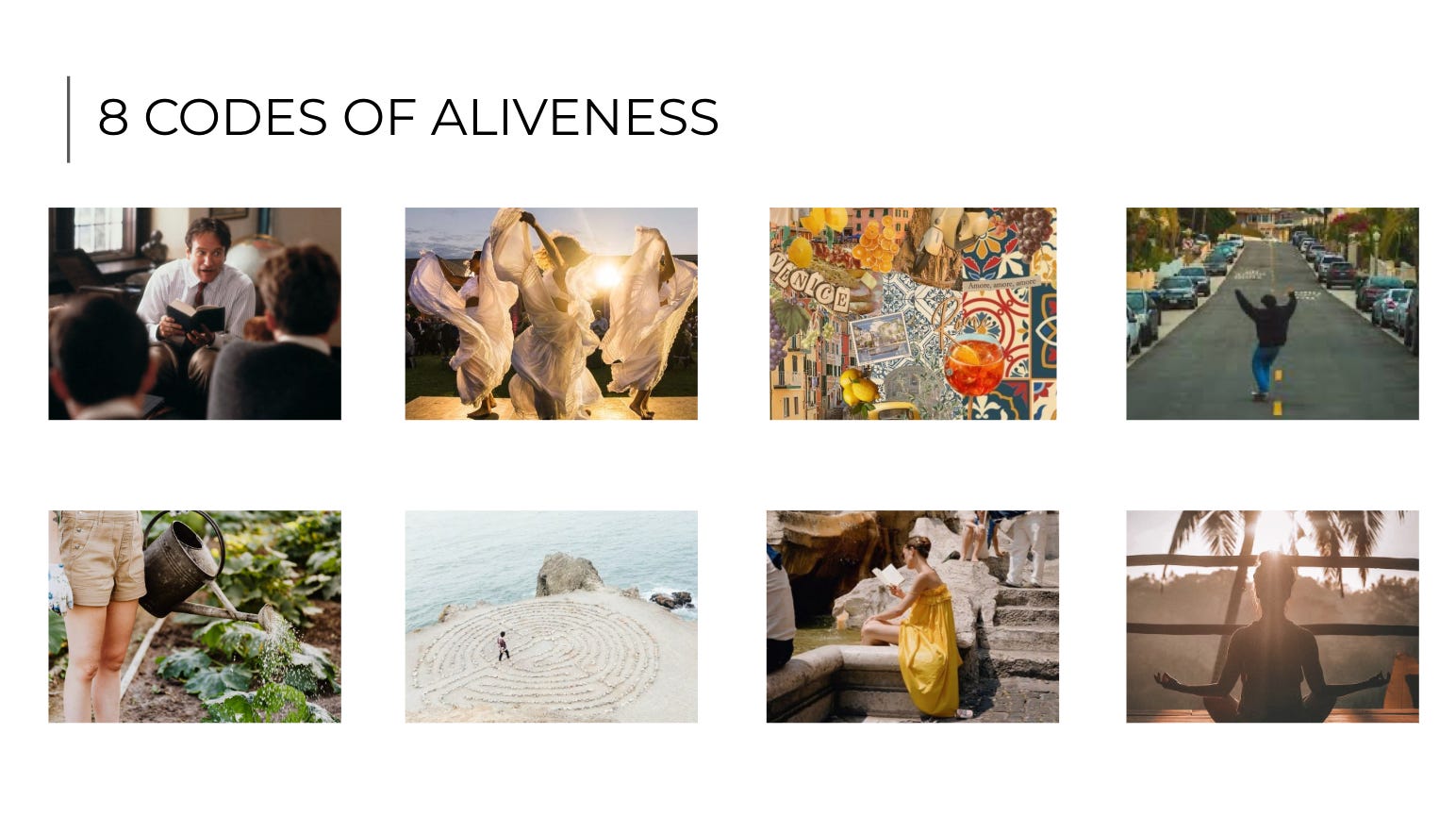
For example, when Lexus decided to launch the RZ, their first electric vehicle, we needed to think about how to position it in a market where it wasn’t the only vehicle that was electric, and not even the only premium/luxury electric vehicle. We wanted to speak to the truth of the vehicle and communicate to the US market that what distinguishes the RZ from competitors is the attention the engineers paid to creating a sense of “aliveness” while driving the RZ. To help get the strategic planners ideating for Lexus’s consumer research events and eventually for writing the brief, I did a semiotic analysis of the concept of aliveness. The analysis revealed 8 codes that then became the inspiration, both verbally and visually, for the team to write three positioning territories. These codes were mapped out on a semiotic square and developed in full, with examples from brands and culture, and included imagery and language.
Ethnographic and Qualitative Research
At other times, the type of knowledge needed to build a brand (or vehicle) strategy is deeper insight into the brand’s audience or target customers. It is not just the agency-side strategy team that this kind of anthropological work supports; there are also many instances in which the client marketing team, consumer insights team, brand managers, or executive leadership need a qualitative study to support some of their workstreams or key business decisions.
A few years ago I was asked to bring to life the target audience for mid-size luxury SUVs in the United States. This type of ask is common in my line of work, because it helps team members across the business understand who their business is for. I’ve found that without the kind of clarity that comes from being immersed in the real lives of real people, business decisions end up being made based on assumptions, even with the purest of intentions.
Different projects have different budgets, and qualitative research can often be done with even very small budgets, but for this mid-size luxury SUV consumer deep dive, there was enough budget for three researchers to spend a couple of days with three different families in three regions of the United States. One of the researchers was also a professional documentary filmmaker, and another researcher (me!) was also a professional photographer. We spent 2-3 days in each location — North Carolina, Texas, and California — with each family, conducting an ethnography and creating short films we called ethnodocs. We did interviews with each of the parents, observed family life, spent time traveling in their vehicles with them, attended their children’s extracurricular activities, went out to eat with them, and just generally got a taste of a typical week in their family life. One of the women also did 6 am bootcamp every morning before work, so you can bet that we were in that suburban parking lot at 5:54 am, ready to suffer alongside her. In true anthropological fashion.
At the end of the project, we had three short films, a research lookbook, and research presentations of various lengths to give everyone in the agency working on the project insight into the lives of the people they were creating ads and communications for.
Between the semiotic and cultural analyses on one end, and the ethnographic and qualitative research on the other, understanding culture and audience covers a wide range of methods — but the common thread is that this work happens before a brand decides what to say. It’s the foundation that positioning, briefs, and campaigns get built on, whether that foundation is a set of cultural codes, a family’s typical Tuesday, or a graph of family personality types.
2. Gathering input to evolve ideas
The second pillar is where anthropology’s role shifts from building understanding to testing it: taking a positioning, a name, or a brand’s own sense of itself, and checking it against how people actually think and live.
The impact of this type of work is aimed primarily at the creative team in an agency who are developing creative concepts, platforms, or campaigns. It is also particularly useful in helping executives on the client side to design their services or make important business decisions.
There are a lot of misconceptions about working in branding or advertising, and this is not the space wherein I will detail them all. But what I always explain to people I meet outside of the industry is that my job is just as much about impacting the brand or the client team as it is about impacting consumers. Sometimes the whole point of the work is to persuade the brand. It is not, like many people think, to convince people to buy more stuff. People are already choosing to travel and to book a hotel. How can the hotel design its services and programs so that it does a better job of being a place that people feel good in?
These might be some of my favorite projects. And that is because doing anthropological work that gathers input and supports idea creation allows me to very concretely see the impact of my work. It’s also fun for my research participants because they get to see that their thoughts and opinions matter. Clients also get the sense of security that they are making the right decision. Win-win-win.
In crude research terms, this type of work might be broadly labeled as ‘concept testing.’1 And concept testing is something that I help teams with — taking three finished name options into research, say, and coming back with a read on resonance, interpretation, and fit with the brand. But more often than that, I am brought in during the ever-evolving ideation phase to help teams as they continue to develop the strategic ideas, the creative platform, or even entire service platforms (like loyalty programs or rewards cards). The ideas that come to me are half-baked and in need of some input from real people!
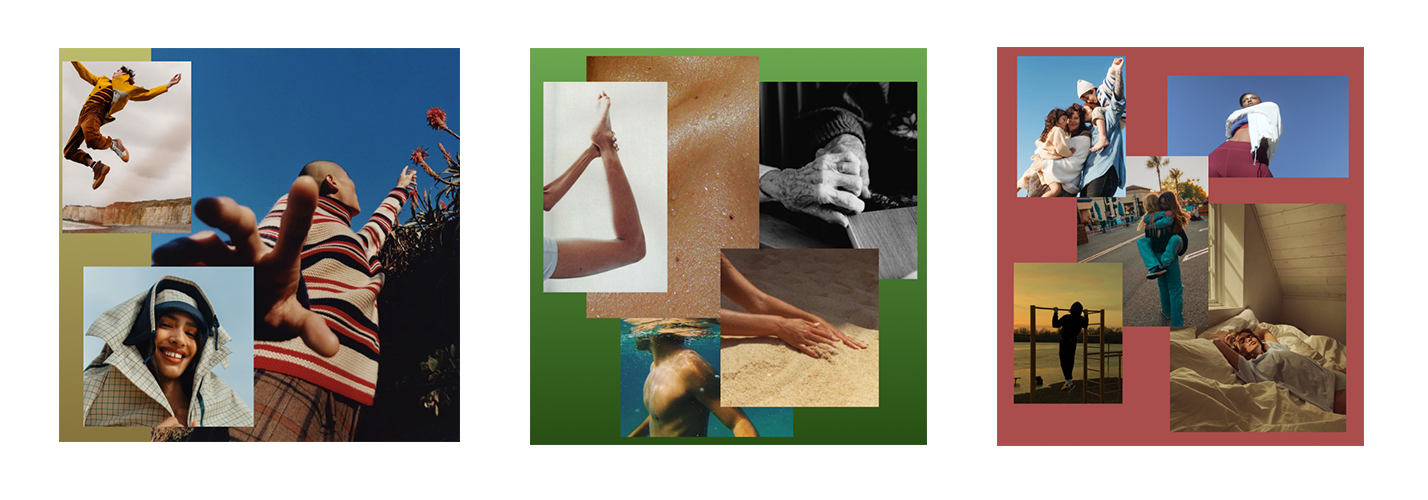
Here I’ll use the example of Vuori, because I’m obsessed with it as a brand (and have a closet full of their pieces) and because it was a favorite pitch (and win!). The pitch team asked me to take the three creative platform ideas in a very rough form into research to get some input from the target Vuori customer. I put together a digital qualitative research plan in which the research participants would review three concepts that included a manifesto, imagery, and “ad-like mockups” to help us understand what was working, what was resonating, and what wasn’t.
But because I’m an anthropologist rather than someone trained as a market researcher, I couldn’t leave it at just that. I wanted to use the time and space I had to get to know these research participants so as to bring ideas for even greater alignment of the brand to their actual lifestyle. Before I even showed the participants the creative platforms, I designed a few activities that helped me give the team (and ultimately the client) an elaborate picture of what the target consumer was like as a person, the lifestyle they lived, the things in their lives that made them feel they were living at their personal peak, and the impact that movement had on their lives.
By designing for two research goals — feedback AND deeper knowledge on the Vuori ideal customer — I was able to bring recommendations for enhancements and modifications that the creatives could actually act on.
3. Fueling creative execution
The third pillar is about what happens once the strategy exists and someone has to bring it to life. Projects within this pillar aim to help the creative team working on writing copy and bringing campaigns to life through TV, print, social media, OOH, and so on.
Projects that are scoped in support of agency creative teams are infrequent in coming across my desk. I’m not sure if it’s because creatives prefer to have their own ideas, or if calling in the local anthropologist just isn’t top of mind. Whatever the case, they are FUN. When the work is for creative execution, my mode is less about being analytical and more about being a collector of stories. As a result, it is often very easy to see the direct line from the research to the creative output, being that it is inspired by stories and examples shared by research participants.
A few years ago, for the release of the latest model of the Lexus LX, audience insights and the strategic brief led to a campaign called “No Moment Too Big.” The LX is a big vehicle. And there are no moments too pressured, no stakes too high, that the LX can’t help you handle. No moments are too big in the lives of high achievers for a vehicle of this size and stature.
Wanting to avoid overplayed stereotypes or a meaningless ad that fails to communicate something about real life to their target audience, the creative team asked me if I could do a bit of qualitative research with some members from my affluent consumer panel.2 They needed real stories of real high-stakes moments these successful people faced, along with an idea of some of the rituals that help them cope or succeed. I reached out to a few of my panel members who I knew fit the bill: overachievers in high positions (and who drive a luxury vehicle of course). I asked them to think ahead of time about some of their most high-pressure moments so that we could discuss them at length. I then pulled together what I had learned and presented it to the creative team, leaving them with a takeaway report that included collective insights and specific examples.
You can see the outcome of that work in the 30-second TV spot below:https://www.youtube-nocookie.com/embed/FixOyPy57aQ?rel=0&autoplay=0&showinfo=0&enablejsapi=0
One final example to bring this to a close (!!).
At the start, I said that the value of anthropology compounds over time. When a brand or agency regularly invests in the type of knowledge that cultural anthropology can provide, the returns on that investment continue to yield dividends because you aren’t buying an answer, but rather building a base of knowledge. A single market research study answers the question in front of you and then expires. As culture and context evolve, so does the single-moment answer a consumer will give you about your product or service. What looked like a trend was a blip. What looked like a blip was the beginning of a structural shift. It takes years of observation stacked on top of each other to tell the difference. The method of inquiry that an anthropologist employs, the depth and breadth of context explored that an anthropologist can’t help but inject into every study, is exactly what produces that ROI.
It’s what allowed a thought leadership study on Modern Affluent Parents to inform the creative execution for the upcoming December to Remember campaign that Lexus will launch this holiday season. For obvious reasons, I cannot disclose details about the strategy or creative of the campaign, but I can tell you that it was made possible as a direct result of an investment in foundational understanding of the lives of affluent American parents today. When designing that study, I did not focus on purchasing habits or brand consumption strictly. I prioritized understanding the value system that structures how they assign meaning to what they encounter as a parent, a consumer, an individual with hopes and dreams.
When I discovered that the team was in need of something fresh and insightful to inspire their work, I knew I could help them get to the answer, and I knew it was because the investment had been made long before the outcome was visible.
]]>Growth is stalling, sales are softening, and even the world’s most loyal high-net-worth shoppers are hesitating—fatigued by price inflation, overexposure, and a creeping sense that the emperor’s new clothes may no longer be tailored in Paris or Milan. From Shanghai to SoHo, status symbols are beginning to lose their symbolic power, prompting a far more existential question: what does luxury mean when everyone can buy in?
At its core, luxury has never been just about price or polish, but rather about symbolic power.
More than a logo
The rare handbag, the grand hotel, the tailored suit that whispers rather than shouts—these things matter because they mean something. Or at least, they used to.
When done well, luxury doesn’t just appeal to the senses; it moves us, encodes status, taste, identity and even aspiration into a single glance. But as brands race to scale, saturate social feeds and pump out logoed goods like ticker tape, much of that meaning has thinned.
The emotional charge that once made luxury feel mythic, even magical, has dulled. But meaning hasn’t disappeared; it’s simply become harder to conjure.
In an age saturated with branding but starved for symbolism, luxury needs more than a logo – it needs a soul.
Carol Pearson and Margaret Mark addressed this problem in branding when they published their work on brand archetypes in their now-famous book The Hero and The Outlaw in 2001. In the simplest terms, an archetype is a character we already know, even if we’ve never met them.
The rebel. The queen. The sage. The innocent. These are not just tropes; they’re primal storylines that have played out across centuries and cultures, embedded so deeply in our collective psyche that they feel instantly familiar.
Archetypal approach
Rooted in Jungian theory, archetypes speak in the emotional shorthand of the collective unconscious.
For brands that are struggling to embody and deliver consistent meaning, typically the issue is a misalignment with their archetypal identity or the failure to develop one in the first place.
But not all archetypes are created equal, and not all brands speak the same emotional language.
The archetypal frameworks popularized by Pearson and Mark have proven influential, particularly in mass and lifestyle branding, where universal roles like the Hero or the Everyman can create broad appeal. Yet luxury operates in a different symbolic register.
It isn’t about relatability, it’s about elevation, mystique, seduction, mastery. It doesn’t flatter the consumer; it enchants them, and enchantment requires its own emotional vocabulary.
That’s what we set out to uncover over the past several years through a research initiative led in collaboration between a cultural anthropologist, a Jungian psychologist and a brand strategist: a system of nine archetypes designed specifically for the luxury category.
Each archetype carries with it a core narrative, for example:
- The Traditionalist: who draws power from heritage and timeless elegance, embodying hierarchy and refined power.
- The Hedonist: who gives permission for pleasure in its most exquisite form, reveling in deserved indulgence.
- The Utopian: who offers wholeness and, through conscious refinement, is woven into daily rituals.
- The Masterful: who commands reverence through unmatched skill, craftsmanship, and genius.
While the execution of that story may evolve with time, the emotional architecture remains constant. This continuity allows a brand to tell stories that feel both fresh and familiar, coherent yet culturally attuned.
Each archetype articulates a distinct emotional proposition—not just a personality, but a worldview. And when used correctly, it operates as a kind of psychological GPS, becoming the internal structure through which a brand can stay culturally relevant while remaining symbolically consistent over time.
It becomes a living symbol, capable of stirring longing, recognition, aspiration—the very emotions that make luxury feel worth the investment.
Core values
In a market flooded with options and noise, many luxury brands are drifting, caught between chasing trends and clinging to legacy, without a clear internal compass.
The result isn’t just creative inconsistency; it’s a loss of symbolic power. Without a coherent emotional foundation, even the most beautifully made product can feel empty.
Consumers may not be able to articulate exactly what’s missing, but they can feel it, and increasingly, they’re deciding it’s not worth the price.
Archetypes offer more than a framework for storytelling; they clarify what a brand stands for at its core. They’re not just tools for marketing, but lenses for decision-making—from product development to partnerships to customer experience.
In a world where meaning is the new scarcity, brands that fail to anchor themselves in a clear emotional identity risk becoming forgettable. And in the realm of luxury, forgettable is fatal.
 ), but what I can say for sure is that I had some money, I had the freedom to build and explore, and I had some guardrails to help guide me in my ideation. Dream.
It was, and continues to be, my favorite part of the work I do. Essentially, it turned out to be an ongoing ethnography, spanning more than 5 years and contributing to countless studies for clients, several new business wins across the agency network, many research insight reports, and thousands of kilometers traveled to present learnings to executives across the US and Europe. Ethnography is the bread and butter of anthropologists; our discipline developed the methodology, after all! Long-term research is a concrete way that I have seen academic rigor produce business results, and in this article I will explain the business impact it has had.
One note: I’ve seen this kind of tool/capability called several different names [consumer insights community, qualitative research panel, consumer panel, online research community, MROC, customer advisory board], and I will use some of them interchangeably in this article. Below, I outline how to deploy a consumer insights community using examples from my own work over the years.
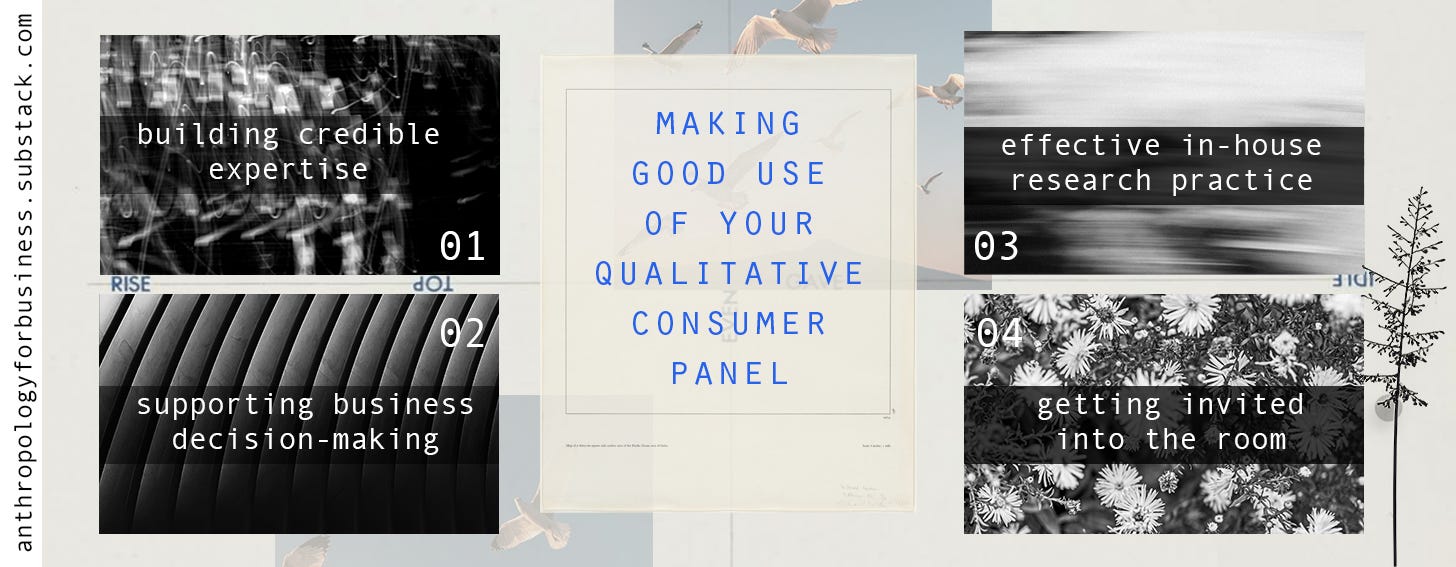
Alright! Let’s get into it. In my experience, the various types of business impact tend to cluster around four main themes. And not all four are applicable to every organizational structure, but they are as follows
- Builds credible expertise
- Supports business decision-making of consequence
- Serves as the foundation of an effective research practice
- Gets your company in the room
Within each of these four clusters, there are several ways to use your consumer panel that ultimately drive that business impact.
BUILDING CREDIBLE EXPERTISE
Without getting into the how of running a consumer panel, the mechanics of engaging with a group of people over time on a variety of subjects means that, almost by default, you can build real knowledge and expertise. If you are as pointed as I was in handpicking the right people for my panel (meeting a certain level of affluence, regular international travelers, adhering to a particular mindset as determined by a set of 13 questions) then you will almost certainly become an authority in specific arenas that are of import to your company or agency. For me, that meant having an earned expertise in a subset of global affluent travelers and luxury consumers. With thought leadership being an important way of participating in global business culture today, an insights community primes an organization to be able to do just that.
When you have a real expertise, you are able to accomplish the following:
- You have a POV. In this day and age, we have all witnessed that brands and companies are expected to have a POV. It’s the case on many politicized issues, but it’s also the case in PR. At the agency I was working for, the PR team often came to me with something like, “I’ve seen press conversation around affluent parents refusing to buy their teens smartphones. What can we contribute to this conversation?” From there, I am either able to answer immediately based on past discussions, research, and data, or I am able to quickly discuss with panelists so that we can pitch or respond with our POV. I already have the built-in context of knowing my panelists and their lives, so the POV is far richer than it would be in survey results or in a one-off qualitative study.
- Leadership is better prepared for conversations. In my case, our C-suite executives were often doing interviews, appearing as guest speakers on a podcast, presenting at industry conferences, or attending various leadership councils. Prior to these engagements, I was often asked for a few insights they could share in the conversations they were entering. Furthermore, by virtue of being an agency constantly engaging in new business pitches, the expertise I had built for our agency through the panel often aided leadership in being prepared for conversations with brands that were curious about growing their affluent consumer base.
- It provides the forum for spotting societal shifts. Thankfully, the panel gave me the time and the space to follow my curiosity and investigate shifts that I sensed were coming. As an anthropologist, this brought me intellectual fulfillment. As a business-minded woman, this helped our agency be ahead of the shifts. I’ll give you a concrete example. Back in 2021 and 2022, the conversations I was having during some “catch-up IDIs” with members of my insights community produced some early signals to me that how they think about and inhabit belonging might be shifting. At the time, it wasn’t enough to build a report around, but it stuck with me nevertheless. In 2025, after a conversation I had with a respected colleague on why status matters in social settings, I decided to study how belonging was concretely shifting, starting with the hypotheses I had been developing over the years. After nearly a full year of exploring the subject, I was able to produce a report at the beginning of the year on how belonging is shifting amongst the affluent. Interestingly, I saw McKinsey just put out a similar report.
 This is not the only example I have. There are many shifts, big and small, that we’ve been able to spot before the wider public was aware, precisely as a result of this ongoing qualitative insights community.
SUPPORTING BUSINESS DECISION-MAKING
The role that an insights community plays in business decision-making depends on the type of organization you are, but I firmly believe that whether the panel is run by an agency, a brand, an enterprise, or even a small business — its most useful role can be informing teams and leaders so that they feel confident about the decisions being made.
These are the consumer panel use cases that I have seen guide client decisions:
- Keeping abreast of cultural shifts. One of the agency’s core clients was Lexus, and as their agency-of-record, we were always seeking ways to add value and use our proprietary knowledge to support their internal initiatives, particularly when it overlapped with the strategy and creative we produced for them. As the world continues to change, especially with regard to electric vehicles and the massive shifts in the luxury market, we felt it could be useful for several of their teams to put together a research-backed POV on the future of luxury. Selecting the participants from the panel who fit within Lexus’s target customer profile, I ran a study to get a sense of where luxury is heading, how it will fit into their lives moving forward, and how they see Lexus within some of those ideas and concepts. We then presented and discussed our learnings in a workshop with a group of Lexus clients.
- Topical knowledge relevant to the industry. Similarly, one of our luxury hospitality clients was in need of some ongoing insight and inspiration over the period of a year after having a change in leadership and restructuring of their luxury business. Together we decided that a useful value-add would be to bring one topic to the affluent consumer panel per month, followed by the preparation of a mini-report to share out in a casual meeting at the end of each month. Each month I agreed with clients on a topic (e.g., food and bev while traveling, wellness practices, etc) and then proceeded to do 1-2 short digital activities with members of the panel on the subject, analyzed the learnings, and made a mini-zine to walk the clients through. The mini-zines also served as take-home materials that the organization could include in their repository of research/consumer insights. Having those reports, and that ability to have a consumer voice on some of the subjects that were top-of-mind as they worked through service offering improvements, helped to guide some of their internal discussions.
- Concept testing for communications and services. While the previous two examples were about general insight or knowledge, there were also many cases in which the panel helped clients make very specific decisions. After the majority of our clients became aware of the panel and various use cases they might have for it, a recurring favorite ask for them was to get feedback on concepts for ads, or copy, or service programs they were designing. Through concept testing, clients were reassured about launching things into the world because feedback either confirmed that the plans or direction would work well, OR the feedback helped us make changes that would improve the work. One of my favorite examples is from the Ritz-Carlton Kapalua campaign “Restore Yourself to the Wild.” During the creation phase, before launching the campaign, we used the consumer insights community to decide on the final direction for the creative. Here is one example of the output:
- High-stakes decisions. Finally, the panel has also been instrumental in helping organizations during the process in which they are making high-stakes decisions. Obviously, there are many inputs when it comes to decisions of high consequence, but the perspective of the consumer is an important one. Over the lifecycle of the customer insights panel, I was asked to develop and execute numerous studies whose insights would be used in executive meetings or summits while making weighty decisions about the business. This was most common in hospitality, but also occurred in financial services. Without going into too much detail to protect the proprietary nature of such decisions, I will say that I designed studies to understand the consumer experiences, values, and perspectives for the following: a hotel group’s purchase of a wellness brand, a wealth management company’s service design, an exclusive loyalty program design in luxury hospitality, and a bank’s rewards card system.
HAVING AN EFFECTIVE RESEARCH PRACTICE IN-HOUSE
I know that not every organization aspires to having a full-time research capability in-house. But for those that already have or want to have a qualitative research capability, an ongoing qualitative research panel can be instrumental in ensuring the efficacy of your research practice. There are several ways that my insights community fed the qualitative research practice that I led at the agency:
- Quick turnaround research. As many of you know, agency life is fast-paced, and we are often given very little time to achieve enormous things. Sometimes as little as 24-48 hours. However, because I had the affluent consumer panel, I was able to bring research to nearly every project that the strategy team took on. Quick turnaround research, for me, means any project in which I need to deliver some answers in the time span of 1 day to 1 week. Anything more than that was likely for a more involved study. A few examples of projects that required quick answers:
- My CSO and I were invited to present my research to Moët-Hennessy executives in New York. I had less than two weeks’ notice before I needed to cross the Atlantic, present the latest affluent insights report, and personalize it for MH. Having the panel allowed me to do a quick exploration on some connections I wanted to make between the report learnings, the panelists’ values, and premium wines and spirits. This ended up winning us some work.
- We were pitching to win a bank as a new client, and the lead strategist needed some inspiration to complete her ideas. She also wanted to include short video clips of the participants to really bring home the idea during the pitch.
- Together with the Lexus client, the strategy and creative teams were working on a new brand campaign. One of the concepts that the idea was built off of needed a little bit of fleshing out to see how it might be relevant to consumers. A few days before a client workshop, the strategists needed a little help with the concept, so I took it to the panel as a quick question they could elaborate with examples. I had answers for the strategists in less than 48 hours.
- A foundational recruiting base. Thankfully, not all research requires such challenging turnaround times. But whatever the case, timelines are usually shorter than ideal — even three months feels short when the project needs sign-off, recruiting, research, analysis, report-building, and presenting. Typically, I am recruiting on a rolling basis in order to stick to the timeline, and the panel proves to be useful in this case as well. The majority of the research requires participants with some degree of affluence, so I was often able to use the panel as the starting point by inviting members who I knew were a good match for the project. For example, when I was conducting a study for a premium wine and spirits company, I started my recruiting from the panel, inviting members who I knew enjoyed alcoholic beverages and were interested enough that they would be willing to pay a premium on occasion.
- Ensures quality participants. As any researcher or recruiter will know, the most important aspect of any study is having the right participants. You can design the most interesting and thorough study in the world, but without quality participants who are the right fit — none of it matters. Though not every study is made up of the insights community members, and there will always be 1 or 2 participants who aren’t the best fit, having the panel means that a majority of the time you know that you have excellent participants. This is because you know they are who they say they are; they are already versed in research participation and have proven themselves to be thoughtful and articulate; they understand what you are asking them to do; and you already have a lot of context into their lives that adds to the research insights. Of course, there are many studies that have learning objectives for which it is better to have a fresh recruit, but that is a subject for another article. ;)
GETTING INVITED INTO THE ROOM
The final set of examples links back to the first in that once you build a real expertise and have a solid thought leadership practice, people want to hear what you have to say. This may apply more in an agency setting than for a brand or other enterprise, though I can imagine a scenario where your thought leadership gets you invited on a stage somewhere like Cannes or SXSW. Even if clients or potential clients are not interested in whatever data or materials you provide for a wide audience, I have seen that they are able to envision a myriad of questions they would like to ask the panel, especially if you help them along. In addition to the use of the panel for studies, I ran research in order to produce an annual report about the values and lifestyles of the global affluent. In the past few years, these annual reports garnered media attention and resulted in a lot of presenting and strategic consulting opportunities on behalf of the agency. These are just a few of the opportunities that this panel and an associated thought leadership practice provided:
- Presenting to the CEO of a global financial institution.
- Being interviewed and written about in Forbes.
- Being invited to pitch for the media business of an Italian luxury fashion house.
- Being asked to present during executive offsite events or retreats in luxury hospitality and luxury spirits.
- Becoming the “go-to affluent insights person” in a global network of agencies, so as to participate in new business pitches and strategic work beyond just the agency I worked for. (Thus adding value to the network as a whole).
While the above examples are some of the shinier ones, they are certainly not the only instances in which I or someone from my team was invited into collaboration as a result of the consumer panel and its associated insights. I would be hard-pressed to come up with every new business pitch, every client team presentation, every strategy it touched. It was impressive, it was a crowd-pleaser, and most of all — it was fun. Fun for me, fun for the participants, and fun for the agency to highlight across our PR and every room we were invited into.
The through line in all of this is time, and the relationships that time makes possible. Studies end, but a community keeps going, and that continuity is where the credibility, the speed, and the good surprises come from. It’s also why I believe few people are better suited to this work than anthropologists. Anyone can be trained to ask good questions and analyze the answers. Anthropologists are trained in ethnography and relational research, which is a different animal altogether: showing up over the long haul, earning trust, and learning a person’s world well enough to understand the meaning behind what they say. A panel done right is the closest thing I’ve found to bringing the patience of academic fieldwork into the pace of business, and the results speak for themselves. If you’re building a panel, running one, or wondering whether your team needs one, I’d love to hear how it’s going (or how you’re thinking about it). Drop a comment or send me a note. I’m always up for talking shop.
]]>Anthropology is a social science. The easiest way to describe what anthropologists do is to tell you that we study present-day groups of people to understand the social and cultural dynamics that shape how members of that group think about the world and their place in it. A cultural anthropologist will not just describe what a group or person does, they will also be able to tell you why (or why not) that person believes it is the right thing to do, or say, or aspire to. Anthropology is core for understanding how people interpret the world and respond to the things that happen every day.
In business contexts, anthropologists are usually tasked to study groups of people as well, but often framed in a different way than “traditional” anthropology. These groups can be as broad as “Lexus owners” or as pointed as “elderly folks with a chronic heart condition living in rural Wisconsin.” The purpose of studying these groups is to answer a business question or need with the understanding and insight gained during the research: Should we acquire this luxury wellness hotel brand? How do we communicate to affluent families that this vehicle responds to their needs? Which creative ad campaign platform is most aligned with people in their late twenties who are starting to think about getting engaged?
Anthropologists working in business produce knowledge about people — what they believe, what is precious and valuable to them, what their daily rhythms are like, how products and technology are integrated into their lives, what they hope to make happen in the future, and so on. Anthropologists study every facet of what it means to be human, so the application to business and organizations is endless. The catchall term for what anthropologists produce in business settings is insights. Insights carry important implications and are the material from which many businesses make decisions. In my case, insights typically structure how clients craft communications, produce ad campaigns, or design services and products.
I’ll give you an example from a recent project I worked on. I was studying affluent parents1 in the United States, and one of my core thematic interests was their relationship with technology within family life. My participants would tell me that they are extremely intentional in limiting their children’s screen time. Recent headlines and many quantitative data reports will tell you the same thing. But being an anthropologist, and being invited to enter into their family life for a time, reveals something deeper altogether. The “limiting” of screen time comes from a belief that technology is something that ought to enhance the way their children engage in the world. Therefore, technology is “limited” to moments that help foster interaction with others or induce thinking, creating, and problem-solving. Technology is rejected when it fragments or discourages those things. Limited doesn’t have to mean time of use; limited can also mean purpose of use.
A quantitative data point will tell you that screen time is reportedly decreasing. An anthropologist will tell you the values and beliefs that underscore which categories of screen time feel morally good and which are to be avoided.
It’s not that the qualitative research methods anthropologists employ are better than quantitative research. The two can and should work in tandem, because they bring different parts of the answer. From what I’ve seen in many years of experience, most research — most business thinking, period — starts with audiences and segments: groups defined by what they buy, how old they are, where they fall on a chart. It is a look from above, or from the outside. Anthropology starts somewhere else. It starts with people, situated in the social and cultural worlds that make their choices reasonable to them. It starts with a look from the inside.
That distinction, between studying from the outside and studying from the inside, alongside your research participants, is at the heart of the discipline of anthropology.
So, concretely: what does that look like as a job?
For me, working in branding, advertising, and communications, it looks like doing ethnography and running qualitative research studies to support luxury and premium brands in making business decisions. At times, it means helping creative or media agencies by doing research with people so that they can build effective brand strategies, design a media plan, envision a creative ad campaign, or win a new client for their agency roster.
It also looks like showing up to meetings with marketing teams, strategy teams, or even creatives, to offer a different view on things. One that is grounded in behavioural theory and informed by an anthropological perspective2.
At other times, it has looked like designing and executing qualitative and quantitative research, followed by writing and producing reports or presentations for companies’ thought leadership. The affluent parenting example I mentioned above was for an agency to have an interesting and informed take on the aspirations of modern affluent parents in the United States. This gave the agency a leg up in new business pitches or with current clients, to demonstrate a deep knowledge of modern parents and how to design products and communications for them.
Other anthropologists I know are doing other things: they are inside product teams shaping how software gets built, or embedded in innovation labs deciding what a company should make next, or advising on how organizations understand their own culture, or doing policy work, or leading internal conversations about technology and ethics; the list goes on, and the opportunities are limitless.
Anthropology is the study of what it means to be human. And business is one of the core aspects of being human in today’s world. Wherever those two things meet, some version of this work is happening, whether or not people realize it.
]]>